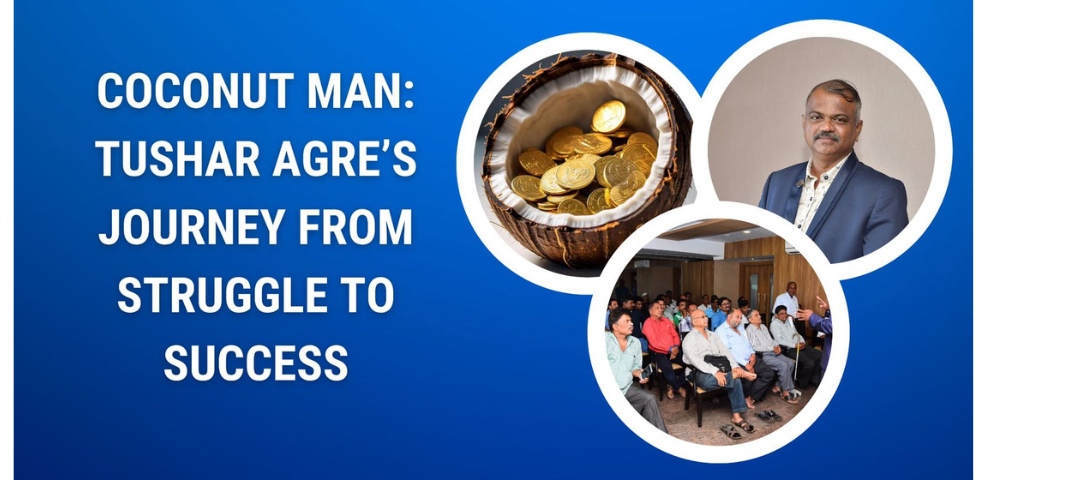
Coconut Man: Tushar Agre’s Journey from Struggle to Success
How a Kokan-focused entrepreneur built a scalable agri-business model around coconut farming
In India’s startup ecosystem, success stories often emerge from technology, finance, or urban innovation hubs. But every once in a while, a grassroots entrepreneur rewrites the narrative—by turning a traditional sector into a scalable business opportunity. Tushar Agre, widely known as the “
Coconut Man”, is one such entrepreneur who is transforming coconut farming into a structured, profitable, and employment-generating venture.
From failed business experiments in Mumbai to building a niche
agri-enterprise in Ratnagiri, Agre’s journey reflects resilience, calculated risk-taking, and a sharp understanding of untapped markets.
The Early Hustle: Learning Through Failures
Tushar Agre’s entrepreneurial journey didn’t begin with success—it began with struggle.
After completing a diploma in engineering in 1999, he faced the harsh reality of job instability.
Like many aspiring entrepreneurs, he experimented across industries:
Paper bag manufacturing
Direct sales of vacuum cleaners and water purifiers
Technical roles in industrial companies
While he eventually secured a stable position in a cooling tower company and rose to a leadership role, the desire to build something of his own never faded.
Each failure became a learning curve—teaching him sales, operations, customer psychology, and the importance of adaptability.
The Defining Decision: Leaving Mumbai
In
2010, a Kokan-focused event became the turning point. Standing at Raigad Fort, Agre made a bold decision—to leave the comfort of Mumbai and explore opportunities in rural Maharashtra.
In April
2011, he shifted to Ratnagiri without a detailed business plan.
“
I didn’t move with certainty. I moved with belief,” he recalls.
This decision marked the beginning of a completely new entrepreneurial chapter—one rooted in agriculture.
Spotting the Gap: Where Farming Meets Opportunity
Agre’s entry into agriculture was accidental but insightful. While marketing fertilizers, he noticed a deeper problem:
Farmers lacked scientific knowledge
Input decisions were often based on guesswork
Productivity remained low despite effort
One critical question from farmers stood out:
“
Why do coconuts fall prematurely?”
This curiosity led him to study coconut farming in depth—pests, nutrition cycles, yield patterns, and plantation management.
By 2014, he launched Swarajya Enterprises (now
Swarajya Agro and Allied Services Pvt. Ltd.), focusing exclusively on coconut farming.
The Business Idea: Farming as a Managed Service
What differentiates Agre from traditional farmers is his service-based business model.
Instead of simply growing or trading coconuts, he introduced
“Coconut Management Services”, where farming is treated like a managed operation.
Key elements of the model:
Scientific nutrient and water planning
Tree-wise performance tracking
Pest management solutions
Yield optimization strategies
Each coconut tree is treated as an individual asset, with detailed data recorded and analysed.
This approach brings predictability, scalability, and professionalism to an otherwise unstructured sector.
Scaling Productivity: Turning Biology into Business
One of the biggest breakthroughs in Agre’s model is improving yield timelines and output.
Traditional Model:
Yield starts: 5–6 years
Output: ~150 coconuts per tree
Agre’s Model:
Yield starts: 3–4 years
Output: Up to 300–400 coconuts per tree
This is achieved through:
Monthly nutrient management aligned with plant cycles
Optimised irrigation
Scientific spacing (30 ft × 30 ft)
Focus on new plantation over ageing trees
His approach challenges the emotional attachment farmers have with old trees, encouraging them to adopt a business-first mindset.
Beyond Farming: Building a Coconut Economy
Agre believes the real opportunity is not just in farming—but in value addition.
Coconut is one of the most versatile crops, offering multiple revenue streams:
Coconut water-based products
Coconut milk and derivatives
Coir products (ropes, mats)
Cocopeat for nurseries
Activated carbon for filtration
Decorative and industrial products
Despite this, India lags behind countries like Thailand and Indonesia in processing.
“
Even packaged coconut water sold in our markets often comes from abroad. That’s the gap we need to fill,” he points out.
The Startup Mindset in Agriculture
Agre’s journey aligns closely with startup principles:
Low productivity and lack of value addition in coconut farming
Scientific management + data-driven farming
Replicable plantation and management model
Farming + services + value-added products
Farmer income growth + rural employment
This makes Swarajya Agro not just an agri-business—but an agri-startup with a scalable model.
Creating Rural Entrepreneurs
A key pillar of Agre’s vision is employment generation.
Through training programs, workshops, and on-ground support, he is:
Empowering youth to take up agri-based careers
Creating opportunities for women in rural areas
Building a service ecosystem around farming
This approach reduces migration to cities and strengthens the rural economy.
Challenges in Scaling
Despite strong fundamentals, the journey is not without challenges:
Convincing farmers to adopt new practices
Investment required for new plantations
Limited processing infrastructure
Market development for value-added products
However, increasing awareness and policy support for agri-entrepreneurship could accelerate growth.
Lessons for Entrepreneurs
Tushar Agre’s journey offers powerful lessons:
Opportunities exist in traditional sectors
Failure is part of the process
Market gaps often lie in plain sight
Execution matters more than ideas
Impact-driven businesses create long-term value
The Bigger Vision: From Kalpavruksha to Arthavruksha
Coconut is traditionally called “Kalpavruksha”—the tree that fulfills all needs. Agre’s mission is to transform it into an “Arthavruksha”—a tree that generates sustainable income.
By combining:
Science
Data
Entrepreneurship
Rural engagement
he is building a model that could redefine coconut farming in India.
Conclusion
In an era where startups chase digital disruption, Tushar Agre is proving that real transformation can also happen on the ground—quite literally.
His journey from Mumbai’s uncertainty to Kokan’s opportunity is not just inspiring—it is a blueprint for how traditional industries can be reimagined with modern thinking.
If scaled effectively, his model could turn coconut farming into one of India’s most promising agri-business opportunities—creating wealth, jobs, and a sustainable rural economy.