For a couple of years, "prompt engineering" was the hot new skill — the promise that with the right magic phrasing, you could coax a large language model into doing almost anything. In 2025 the industry quietly moved on from it. The term that replaced it,
context engineering, is not a rebrand. It is a more honest description of what actually makes AI systems work, and it has already started showing up in technical interviews.
Where the term came from
The shift became official in mid-2025. Shopify's CEO, Tobi Lütke, offered what became the canonical definition, describing context engineering as "the art of providing all the context for the task to be plausibly solvable by the LLM." Within days, the former OpenAI researcher Andrej Karpathy endorsed it publicly, calling it "the delicate art and science of filling the context window with just the right information for the next step." Two of the most-followed voices in AI agreeing on a phrase in the same week is how industry vocabulary gets rewritten, and this one stuck.
The reason it resonated is that it named something practitioners already knew: the clever prompt was never the hard part.
Prompt engineering vs context engineering
The distinction is worth getting exactly right, because it changes how you build.
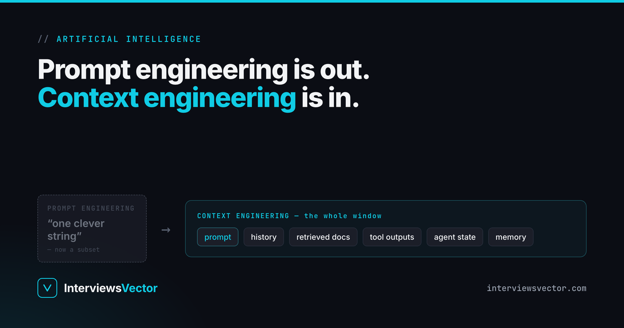
Prompt engineering, as the engineer Philipp Schmid puts it, is about "crafting the perfect set of instructions in a single text string." It treats the model like a vending machine: find the right input, get the right output.
Context engineering is far broader. Schmid describes it as building "a system that runs
before the main LLM call" whose job is to deliver "the right information and tools, in the right format, at the right time." The prompt is still in there — but it is a small slice of a much larger picture that also includes conversation history, retrieved documents, tool outputs, the agent's current state, and knowledge assembled on the fly. Prompt engineering is a sentence. Context engineering is the entire pipeline that decides what goes into the model's limited attention at each step.
Why it's the skill that actually matters
Anyone who has moved an LLM feature from a demo to production has felt the difference. A clever prompt gets you an impressive screenshot. It does not get you a system that stays correct across thousands of real, messy inputs.
Production failures almost never look like "we needed a better-worded prompt." They look like: the model didn't have the document it needed; the retrieval step pulled the wrong context; the conversation history overflowed the window and the important detail fell out; a tool returned malformed output the model then trusted. Every one of those is a context-engineering problem. The model was capable; the surrounding system fed it the wrong things. As LLMs get better at reasoning, the bottleneck keeps moving
out of the model and
into the system that assembles its context.
That is why the skill has stuck around while "prompt engineering" faded. Prompts are a feature of a demo. Context is a property of a system.
Why it's showing up in interviews
Predictably, hiring has followed the work. As companies build real products on top of LLMs, the interview questions have shifted from "write me a prompt" to genuinely architectural problems: How would you design a retrieval system so the model sees the right documents? What do you do when relevant context exceeds the window? How do you manage memory across a long agent session? How do you evaluate whether the assembled context was actually good?
These are systems questions with an AI accent, and they reward the same engineering judgment that senior interviews have always valued — now applied to a new substrate. For engineers preparing, it helps to treat it as its own topic: there is
a full breakdown of context engineering framed specifically for interviews, and it sits alongside broader
AI and machine-learning interview questions that increasingly probe how you'd build, not just use, these systems.
How to get good at it
The path is less about tricks and more about systems thinking. Learn retrieval properly — how to chunk, index, and fetch the right information rather than dumping everything into the window. Treat the context window as the scarce, expensive resource it is, and be deliberate about what earns a place in it. Design for evaluation from the start, so you can tell whether a change to your context pipeline actually helped. In short, approach it the way you'd approach any hard system: this is
designing AI-shaped systems, and the fundamentals of good architecture apply.
The bottom line
Prompt engineering treated the model as the whole problem and the prompt as the whole solution. Context engineering recognises the harder truth: the model is one component, and the real work is the system that decides what it sees. The phrase changed in 2025, but the underlying lesson is an old one for engineers — the value was never in the clever incantation. It was in the architecture around it.
Sources: Tobias Lütke and Andrej Karpathy, on X (June 2025); Philipp Schmid, "The New Skill in AI is Not Prompting, It's Context Engineering".